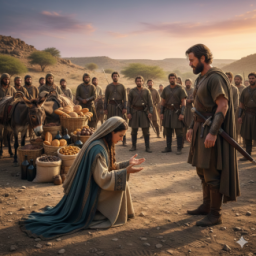

The Song of Deborah
The Song of Deborah (Judges 5) is one of the most remarkable passages in the Bible. It is a triumphant victory hymn sung by Deborah and Barak after the defeat of the Canaanite general Sisera.
Scholars consider it one of the oldest pieces of literature in the entire Bible—potentially dating back to the 12th century BCE. Because it is poetry, it provides vivid, “eye-witness” style details that the prose account in the previous chapter leaves out.

1. The Call to Praise (Verses 1–5)
The song begins with a powerful invocation. It describes God marching from the east (Seir and Edom), accompanied by cosmic events: the earth trembling and the mountains “melting” or quaking.
“LORD, when you went out from Seir… the earth shook, the heavens poured, the clouds poured down water.”
2. The Dark Days of Oppression (Verses 6–11)
Deborah paints a picture of how miserable life was before the uprising. Under Canaanite rule:
- The highways were deserted: People were too afraid to use main roads and traveled only on “winding pathways” to avoid being robbed or killed.
- Village life ceased: Farmers couldn’t work their land safely.
- The Turning Point: Everything changed “until I, Deborah, arose, arose a mother in Israel.”
3. The Tribal “Roll Call” (Verses 12–18)
This is a fascinating historical section where Deborah praises the tribes that showed up to fight and “roasts” those that stayed home:
- The Heroes: Ephraim, Benjamin, Zebulun, Issachar, and Naphtali are honored for risking their lives.
- The “No-Shows”: Reuben is mocked for sitting among the sheepfolds listening to “whistles for the flocks” instead of the call to war. Dan is criticized for “lingering by the ships.” Asher stayed by the coast.
4. The Cosmic Battle (Verses 19–23)
The song reveals the “secret weapon” that defeated the 900 iron chariots. While the soldiers fought on the ground, Deborah describes the heavens joining in:
“From the heavens the stars fought, from their courses they fought against Sisera.”
A sudden, torrential rainstorm turned the Kishon River into a “raging torrent,” sweeping away the heavy chariots as they became mired in the mud.
5. The Tale of Two Women (Verses 24–30)
The song ends with a dramatic contrast between two women: Jael and Sisera’s Mother.
- Jael the Assassin: The song celebrates Jael in graphic detail. It describes her giving Sisera milk in a “lordly bowl,” then striking him with a tent peg. The rhythm of the Hebrew text here mimics the pounding of the hammer: “He sank, he fell; where he sank, there he fell—dead.”
- Sisera’s Mother: In a stroke of tragic irony, the poem shifts to Sisera’s mother peering through a window at home. She wonders why his chariot is late, comforting herself by imagining he is busy gathering “spoils” and “beautiful robes.” The reader, however, knows he is already dead in a tent.
Why the Song Matters
- Historical Evidence: It reflects a time before Israel had a king, showing how the tribes functioned as a loose confederation held together by faith.
- Female Perspective: The song is dominated by female figures—Deborah, Jael, and even Sisera’s mother—highlighting the unique “hand of a woman” prophecy.
- Theological Message: It concludes with a prayer: “So may all your enemies perish, O LORD! But may those who love you be like the sun when it rises in its strength.”
The Song of Deborah is the “grand finale” to her story. After this victory, the Bible says the land had peace for 40 years.