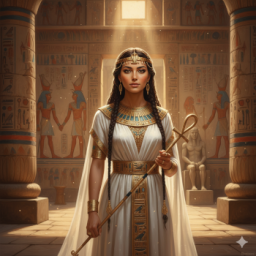

The Story of Abishag
The story of Abishag the Shunammite is found in the opening chapters of 1 Kings. Her role begins as a physical caregiver for an aging King David, but she quickly becomes a central figure in a dangerous political power struggle over the throne of Israel.
1. The Caregiver of the King
The story opens with King David in his extreme old age. Despite being covered with blankets, he could not keep warm. His officials searched throughout Israel for a “beautiful young woman” to serve as the king’s nurse and to lie in his arms to provide body heat—a practice known in ancient times as shunammitism.

They found Abishag, a strikingly beautiful girl from the village of Shunem.
- Her Role: She attended to the king and took care of him.
- The Clarification: The Bible specifically notes that although she lay with him to keep him warm, the king “had no intimate relations with her” (1 Kings 1:4). This detail is legally significant, as it preserved her status for what would follow.
2. A Pawn in the Power Struggle
After David died and Solomon was established as king, David’s other son, Adonijah (who had previously tried to usurp the throne), made a move to marry Abishag.
Adonijah approached Solomon’s mother, Bathsheba, and asked her to intercede with the king on his behalf. He requested Abishag as his wife. Bathsheba presented the request to Solomon, perhaps seeing it as a simple marriage arrangement.
3. Solomon’s Decisive Reaction
King Solomon, known for his wisdom, immediately recognized the political danger behind Adonijah’s request. In the Ancient Near East, taking a deceased king’s concubine or wife was a public claim to the throne.
Solomon saw this as a “soft coup” attempt. He answered his mother:
“Why do you request Abishag the Shunammite for Adonijah? You might as well request the kingdom for him!” (1 Kings 2:22)
Because Adonijah had tried to claim royal status through Abishag, Solomon ordered his execution that very day, viewing the request as an act of treason.
Why Abishag’s Story is Significant
- Political Symbolism: Abishag was the “living symbol” of David’s kingship. Control over her represented control over David’s legacy.
- Silence of the Subject: Like many women of her time, Abishag has no recorded dialogue. She is a figure whose life is directed entirely by the political maneuvers of the men around her.
- The Song of Solomon: Many biblical scholars and traditions suggest that Abishag is the “Shulammite” woman (a variant of “Shunammite”) featured in the Song of Solomon, though this is a subject of much debate.
Hometown — Shunem (in the territory of Issachar)
Primary Duty — Keeping King David warm and nursing him
Status — Virgin concubine of the King
Conflict — Requested as a wife by Adonijah, leading to his death
Abishag’s story is a bridge between the reign of David and the reign of Solomon, illustrating how even an act of nursing care could be entangled in the high-stakes politics of the royal court.