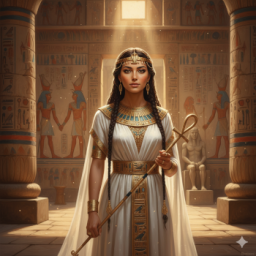

The Story of Bilhah
The story of Bilhah is a significant, yet often overlooked, part of the Book of Genesis. As the mother of two of the twelve tribes of Israel, her life was defined by the complex and often painful family dynamics of the patriarch Jacob.
1. From Servant to Matriarch
Bilhah was originally the handmaid of Rachel. When Rachel married Jacob, her father Laban gave Bilhah to her as a wedding gift.
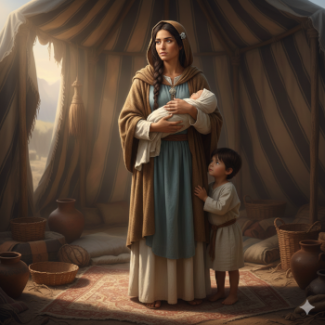
The major turning point in Bilhah’s life came during the “birth race” between the two sisters, Leah and Rachel. Because Rachel was initially barren and envied her sister’s many children, she followed the custom of the time (also seen with Sarah and Hagar) and gave Bilhah to Jacob as a surrogate wife.
“She said, ‘Here is Bilhah, my servant. Sleep with her so that she can bear children for me and I too can build a family through her.'” — Genesis 30:3
2. The Mother of Two Tribes
Bilhah gave birth to two sons, whom Rachel claimed as her own and named. These two sons became the founders of major tribes of Israel:
- Dan: His name means “Vindicated” or “Judge.” Rachel declared, “God has vindicated me,” when he was born.
- Naphtali: His name means “My Struggle” or “Wrestling.” Rachel named him this to represent her intense rivalry with Leah.
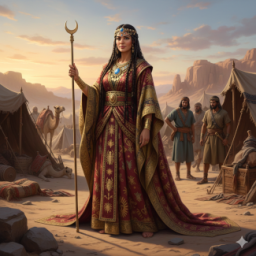
Despite being a “secondary” wife or concubine, Bilhah is often referred to by scholars as a “Secondary Matriarch” because 1/6th of the nation of Israel descends directly from her.
3. The Incident with Reuben
After the death of Rachel, a dark and controversial event occurred involving Bilhah and Jacob’s eldest son, Reuben.
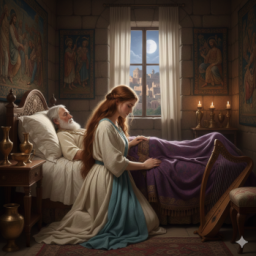
Genesis 35:22 briefly records that Reuben went and “lay with” Bilhah. Most biblical scholars view this not just as a sexual sin, but as a political power play. In the Ancient Near East, taking the father’s concubine was a way of asserting authority and claiming the position of head of the family.
The Consequences:
- Jacob did not react immediately, but he never forgot.
- On his deathbed, Jacob stripped Reuben of his birthright (the double portion of inheritance and leadership), citing this act as the reason: “Unstable as water, you shall not excel, because you went up to your father’s bed.” (Genesis 49:4)
4. Legacy and Traditions
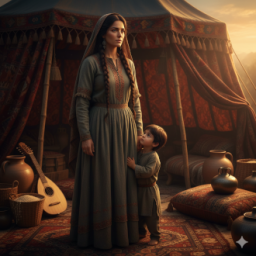
- The “Mother” of Joseph and Benjamin: Jewish tradition (Midrash) suggests that after Rachel died, Bilhah stepped in to raise Rachel’s young sons, Joseph and Benjamin, showing her a high level of care and maternal influence in the household.
- The God of the Matriarchs: While traditionally only Sarah, Rebekah, Rachel, and Leah are named as matriarchs, many modern traditions now include Bilhah and Zilpah in prayers to honor the fact that they are the biological mothers of four of Israel’s tribes.
Bilhah’s story highlights how God worked through the messy, human structures of the time to build the nation of Israel.